




Challenge
A local Midwest government entity needed a comprehensive understanding of its cybersecurity posture but lacked a framework to measure maturity, identify gaps, and prioritize security investments. Although the organization maintained strong day-to-day technical operations, key areas such as cybersecurity governance, policy management, risk management practices, workforce security awareness, and documentation were not consistently formalized or measured. City leadership needed an objective assessment to:
- Align cybersecurity activities with business priorities
- Establish a clear current-state security profile
- Identify risks
- Provide a practical roadmap for improving security maturity over time
- Support executive-level decision-making
Provalus was engaged to provide structure, insight, and actionable recommendations to advance the client’s goals.
SOLution
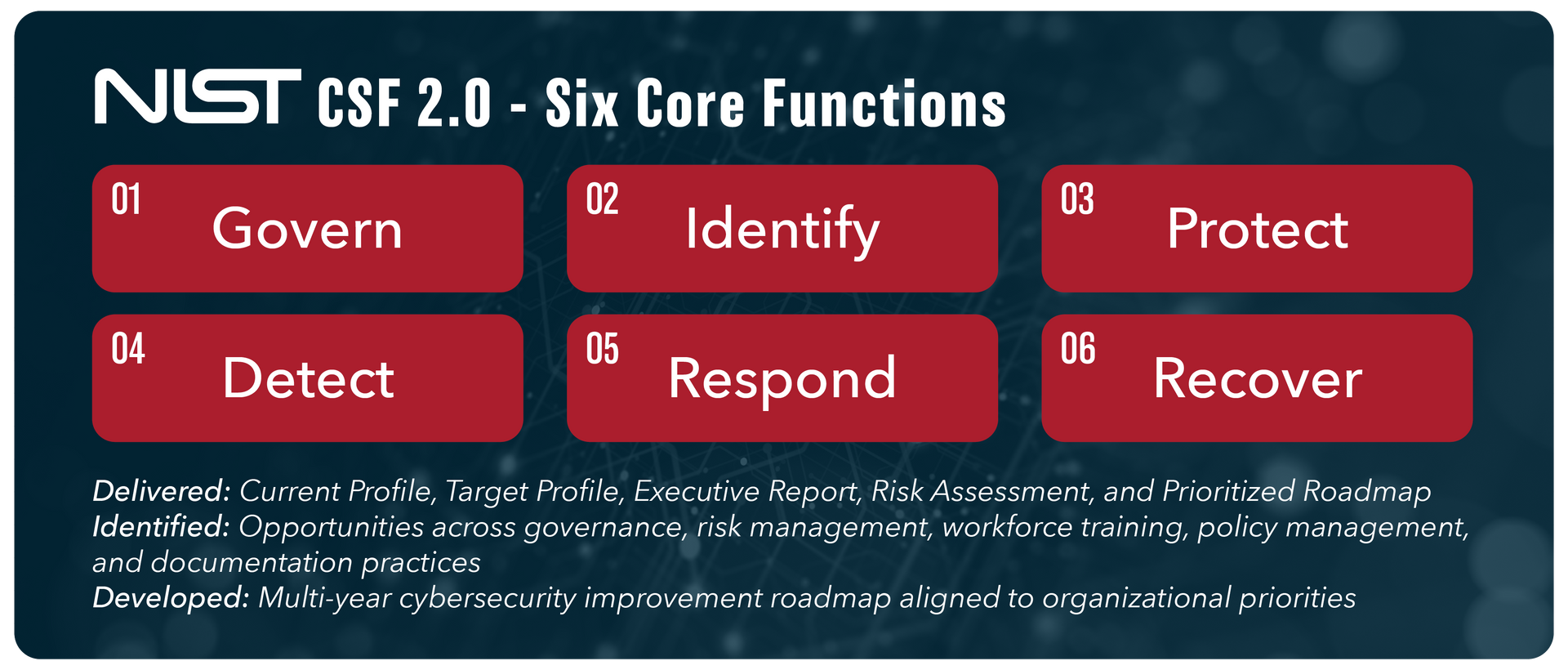
Provalus delivered a structured NIST Cybersecurity Framework (CSF) 2.0 assessment and roadmap engagement, performing:
- Stakeholder interviews
- Policy and technical control reviews
- Operational and governance process evaluations
Cybersecurity maturity was assessed across all NIST CSF functions, with both current and target profiles developed with detailed risk identification, gap analysis, maturity scoring, and executive-level reporting. Technical findings were translated into actionable business recommendations, and a prioritized multi-year improvement roadmap was created. The client received a comprehensive cybersecurity maturity baseline aligned with NIST CSF 2.0, giving leadership clear visibility into strengths, weaknesses, and priority initiatives—creating a foundation for informed budgeting, strategic planning, and sustained security improvements.

Impact
Today, the client has a clear, data-driven understanding of its cybersecurity maturity and a practical, prioritized roadmap for strengthening resilience over the coming years. Leadership can now make more informed decisions regarding risk, governance, and security investments, while IT teams are aligned with initiatives to support both organizational objectives and industry-recognized best practices. The engagement shifted cybersecurity discussions from reactive technology management into strategic business conversations supported by measurable outcomes, defined priorities, and executive-level visibility. The organization now has a repeatable framework for continuously improving cybersecurity maturity, building on a strong operational security foundation.