

7 Questions to Ask an IT Outsourcing (ITO) Provider
The pitch deck was impressive.
The 200-page RFP response is thorough. Both the certifications and the methodologies are documented, and neither of them is verifiable.
This is the moment every IT leader has lived. The provider who wins the bid is the one whose writing team is best, not the one whose NOC actually answers the phone at 3 a.m. The proposal is the artifact you're evaluating. The operation is what you'll inherit.
Forget the better template. The question itself needs to change. Stop asking providers to describe what they do and start forcing them to show what they've already done.
Below are seven questions, with 2026 benchmarks for what "good" looks like and the red flags that signal performance over operation. Six are questions to ask the vendor. The seventh is the question to ask yourself. The questions apply to any technical support outsourcing provider, in any delivery model.
What IT Outsourcing (ITO) Actually Covers
Most buyers treat IT outsourcing as a single category. It splits into four distinct scopes: Tier 1 and Tier 2 help desk, Tier 3 escalation and application support, NOC and SOC operations, and infrastructure and cloud support. Some providers own one of those. Others run all of them. Which matters depends on where your risk actually sits.
The seven questions below apply regardless of which delivery model your shortlist runs on.
Question 1. Can you show us a real scorecard?
Every provider has a pitch deck. Most also have something they call a scorecard. Those are not the same document. The pitch deck shows composite CSAT scores, marquee logos, and the certifications they're proudest of. The scorecard shows what they actually measure week to week. Ask for the second one. If they hesitate, you already know something.
What good looks like
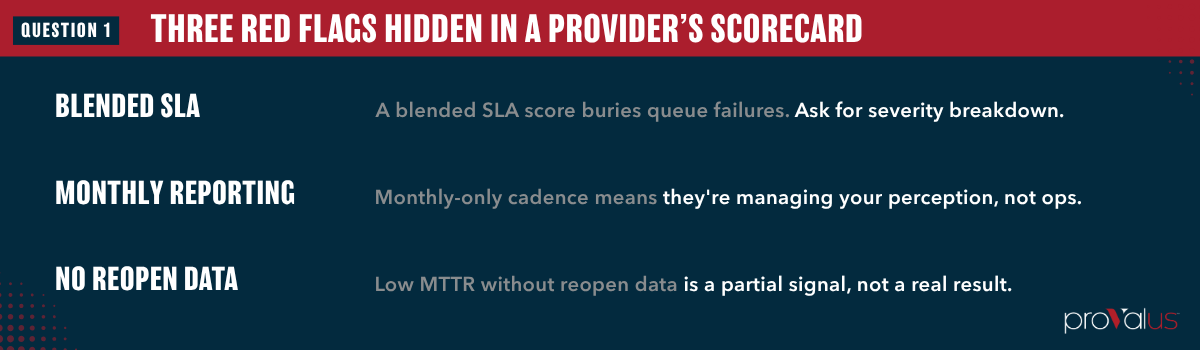
A solid technical support operation in 2026 should be hitting First Call Resolution somewhere between 70 and 79 percent, with world-class providers clearing 80. But FCR alone is a partial read. The number that carries more weight is the reopen rate, because a ticket that closes and reopens within seven days was never actually resolved. It was deferred. Suspiciously low MTTR paired with a high reopen rate usually means agents are being rushed off tickets to hit SLA, at which point the SLA has stopped telling you what you think it's telling you.
Backlog age needs its own cut by priority: P1 tracked in hours, P2 in days, P3 in weeks. Rolling all three into a single composite buries three different operational realities in one number. SLA attainment should come back by queue and severity tier, never blended into a program-wide average.
What to watch for
Three patterns show up when a provider is hiding behind aggregation. Aggregate-only reporting buries program-level failure inside company-wide averages. Composite dashboards drop the severity breakout entirely. A monthly-only reporting cadence usually means the provider isn't running daily operations against daily metrics. At that point, they're not measuring performance. They're managing your perception of it.
The proof point
Ask for the scorecard from the queue closest to yours in volume, severity mix, and complexity. If they won't share it, you have your answer.
Question 2. What are your workforce stability numbers?
In technical support, retention is the difference between a team that resolves your tickets and one that relearns your environment every six months. Every L2 engineer who walks out takes six to twelve months of institutional knowledge with them. If your provider's attrition rate is 30 percent, your team is permanently in a state of partial competence. Attrition isn't an HR problem. It's a continuity one.
What good looks like
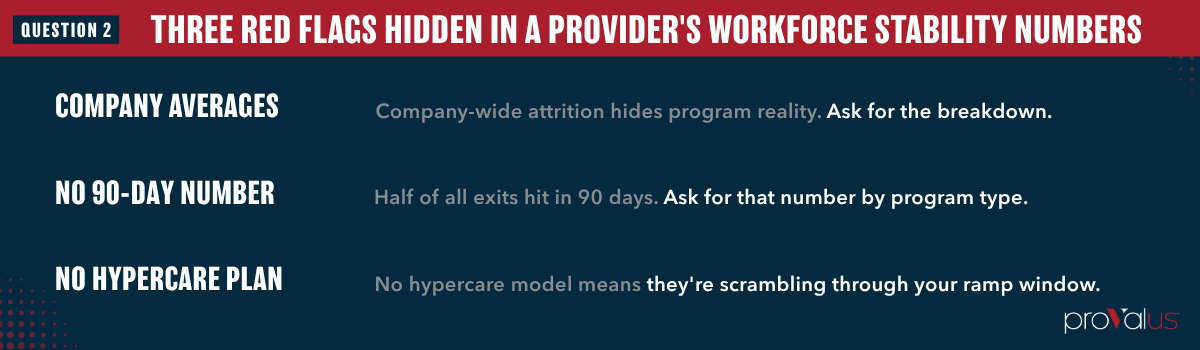
Industry attrition in IT outsourcing runs 30 to 45 percent, with some centers approaching 50. Roughly half of all exits happen within the first 90 days, which is why 90-day retention correlates more tightly with transition failure than annual attrition does. Deloitte's research on contact center economics puts a number on it: a 1 percent reduction in agent attrition saves a 30,000-person organization $32.9 million annually.
A designed staffing buffer in the first 90 days is operational maturity. Scrambling to retain people after the first wave quits means the provider didn't account for their own attrition risk, and you're the one absorbing it.
What to ask for
Ask for these specific numbers, not company-wide averages: 90-day retention rate by program type and size, annual attrition by program type and size, median tenure for the relevant role, and a documented hypercare model for the first 90 days.
Why their answer needs to be defensible against the labor market
Attrition numbers only mean something against the provider's local labor market. A provider claiming 15 percent attrition while competing against 40 other technical employers in the same city needs to show the math, and so does one claiming the same number from a market where they have a structural talent advantage. Ask what makes that number defensible. If they can't answer it, the number isn't.
What to watch for
The warning signs are recognizable: company-wide averages with no program breakout, no disclosed 90-day retention number, no documented hypercare, and tenure measured in months instead of years.
Question 3. Can you prove your security and compliance posture?
Most providers will tell you they're SOC 2 compliant. Far fewer will hand you the report. Those are different things, and the gap between them is where compliance posture actually lives.
Type I vs. Type II
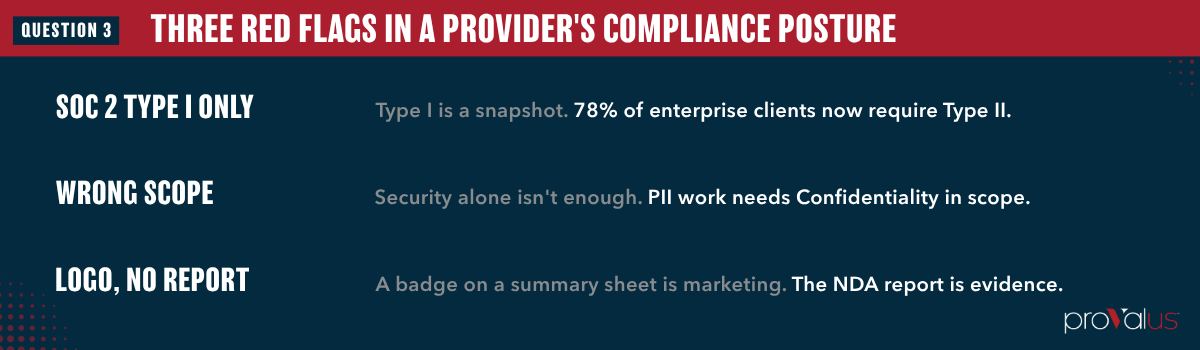
A SOC 2 Type I attests to controls at a single point in time, essentially a snapshot. A SOC 2 Type II covers operating effectiveness over three to twelve months, which makes it less a photograph and more a video. Gartner's 2024 Security Compliance Report found that 78 percent of enterprise clients now require SOC 2 Type II from service providers. The era when a Type I was a credible signal is over.
Scope matters as much as type
SOC 2 includes five Trust Service Criteria, and only Security is mandatory. The other four (Availability, Processing Integrity, Confidentiality, and Privacy) are optional add-ons that providers scope based on the work. For technical support involving customer data, regulated information, or PII, the scope should match what the provider will actually do, not what looks best on a summary sheet.
Beyond SOC 2
Compliance posture runs wider than SOC 2. Mature providers can speak to all of this: BCP and DR testing cadence (monthly restore tests, quarterly tabletop exercises, annual recovery exercises), HIPAA work including BAA templates and contingency plan components, PCI certification level and AoC, and data residency specifics covering where the data lives, what jurisdiction governs it, and whether any scenario moves it across borders.
The proof point
Ask for the Type II report under NDA, with the right Trust Service Criteria in scope and a current audit window. That's the evidence. A certification logo on a summary sheet is the marketing version of the same claim.
Question 4. What does a transition plan typically look like as your organization inherits from either an internal team or an existing vendor?
Buyers evaluate providers on steady-state performance, but a lot of them never get there because they fail during the transition.
Why transitions fail
Most outsourcing contracts involve one of two handoffs: an internal team passing work to an outsourced provider, or an existing vendor passing it to a new one. Both fail the same way. The new provider walks in without a complete picture, because the people who actually knew how the work ran were never required to write it down. Internal teams lived the process. Vendors had no incentive to document on the way out. In both cases, the new provider rebuilds the picture in production, on your account.
What good looks like
A typical BPO transition runs 12 to 32 weeks, with an overhead of 2 to 3 percent of the contract value. Productivity lag in the first 12 to 24 months runs 3 to 27 percent, with some research showing a decline of up to 20 percent across the first two years. What separates a real methodology from a template is the presence of specific artifacts: a documented pilot phase with measurable success criteria, SLA floors that apply during ramp with defined minimums and corresponding penalties, a single named transition owner, runbooks and SIPOC documentation that outlive individual employees, and rollback criteria with named thresholds at which the contract reverts or pauses.
What to watch for
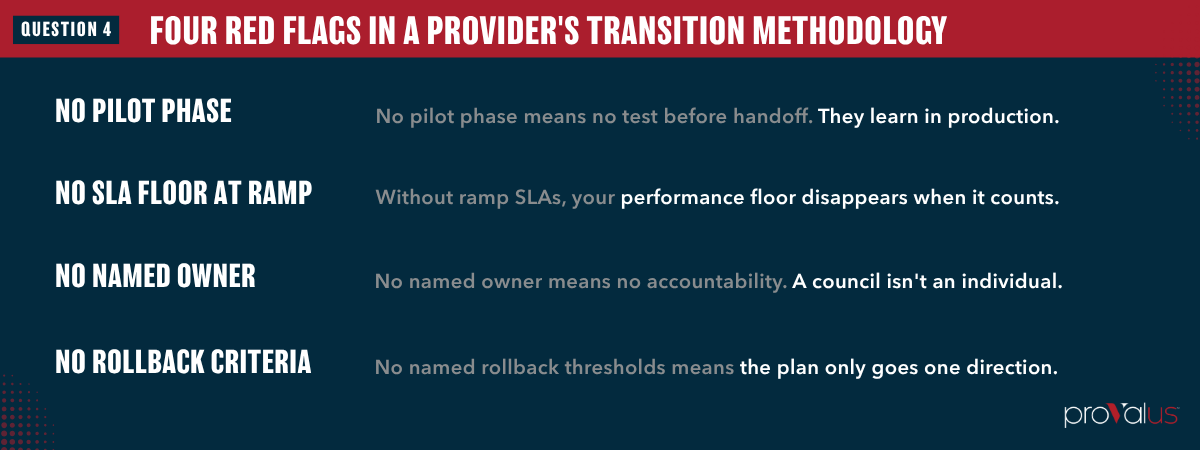
Watch for the absence of any of those artifacts. No documented pilot means there's no test before the full handoff. No SLA protection during ramp means your performance floor disappears at the moment you need it most. A governance council listed as the transition owner is not an owner. It's distributed accountability, which in practice means nobody owns it. KT framed as "we'll shadow your team for a few weeks" means the provider is planning to learn your environment on your dime. And if there are no rollback criteria, there's no defined exit if things go wrong.
The proof point
Ask for the redacted transition plan from a comparable migration in the same category. If the provider can't produce one, they don't have a methodology.
Question 5. How do you ensure scalability without degrading quality?
Buyers evaluate providers on what they can deliver today. The harder question is what they can deliver during a 60-day ramp without burning down service quality to hit hiring commitments. Those are different problems, and most providers only have an answer to the first one.
Every provider has a maximum ramp rate at which they can hold quality. Above that rate, quality degrades. The mature providers know exactly where that rate is because they've hit the ceiling and managed it. The ones who haven't found out in production, on your account.
The ask is specific: documented maximum ramp rate by program size, maintained SLA, MTTR, and reopen rate during ramp rather than just at steady state, pipeline depth in the provider's actual labor markets, and a recruiting funnel story that holds up against the math.
Business continuity is part of the same conversation
Single-location providers aren't automatically inferior, but they need to articulate their BCP model, overflow plan, and recovery posture clearly. Multi-site providers need to show how they keep quality consistent across sites, because consistency across locations is harder than consistency within one. Both models can work. The one that matters is whichever one the provider can show is documented, tested, and current.
What to watch for
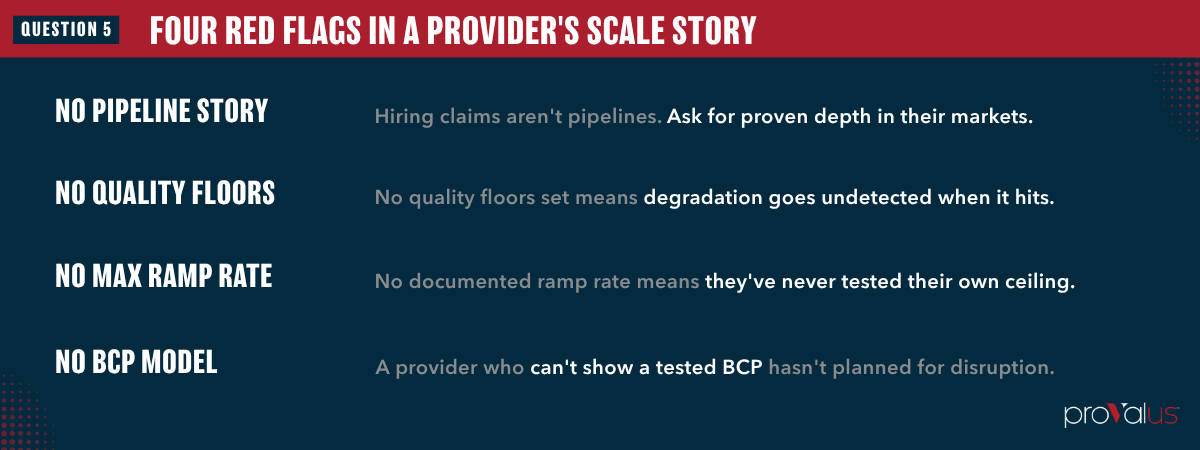
Four patterns flag a provider whose scale story is marketing rather than operations. "We can hire anyone" with no pipeline story means the recruiting funnel doesn't exist yet. Scale claims with no quality floors means the provider hasn't defined what degradation looks like, which means they won't catch it when it happens. No documented maximum ramp rate means they've never stress-tested their own ceiling. No articulated BCP model means continuity is theoretical.
The proof point
Ask if they've ever told a client "no" on a ramp request because quality would degrade. Providers who have faced that call know exactly where their ceiling is. Providers who haven't will tell you their ceiling doesn't exist, which is how you know it does.
Question 6. How do you manage knowledge and drive continuous improvement?
Most providers will tell you they have a knowledge management process. Far fewer can show you what it produces.
In a serious operation, knowledge management runs as a continuous loop. Tickets generate insights, insights update the knowledge base, the knowledge base reduces ticket volume on the same issue, and the cycle repeats. When the loop is closed and short, deflection rates rise, AHT falls, and FCR climbs. When it's open or slow, the operation gets more expensive over time, not less.
What good looks like in 2026
AI capability lives here, too, but whether the provider uses AI is the wrong question. In 2026, most do. What matters is what's actually in production today, what it's measurably doing, and what before/after KPIs the provider can show from a comparable program. Automated QA coverage is rising as a category standard, moving from the 2 to 5 percent sample review of the last decade toward much broader coverage. Mature providers run weekly root-cause analysis on non-FCR interactions, with knowledge base updates closed inside the same sprint. Monthly RCA is too slow to prevent repeat tickets.
Commercial accountability
Serious providers tie continuous improvement to commercial commitments, not just SLAs. That means backlog reduction percentages, FCR improvement targets, and gain-share structures on deflection tied into the contract itself. Providers who won't commit to outcomes beyond SLA attainment have drawn their accountability boundary at uptime. That's the minimum the contract requires. Everything above it is goodwill.
What to watch for
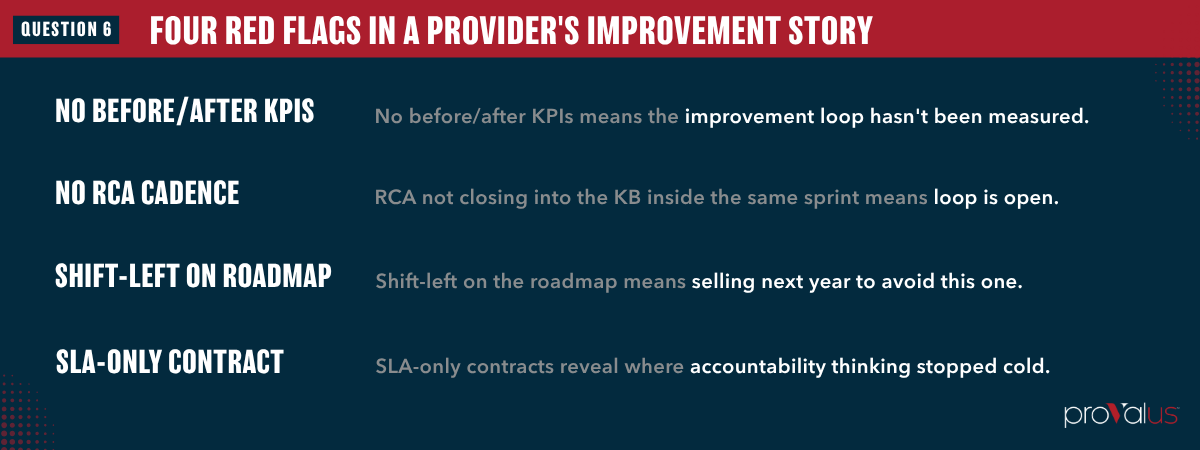
A few things signal a provider whose improvement story lives in the pitch deck rather than the operation. Ask for before/after knowledge KPIs from a comparable program. If they don't have them, the loop either doesn't exist or hasn't been measured. Ask whether RCA findings feed directly into knowledge base updates. If there's no documented cadence, tickets are closing without feeding anything forward. Shift-left framed as a roadmap item with no current capability is the provider selling 2026 to avoid answering 2025. And a contract structured around SLA attainment only tells you where the provider stopped thinking about accountability.
The proof point
Ask what ramp-phase outcomes the provider will commit to in writing, and what happens if they miss.
Internal Question: Question 7. Is this an organization you trust to represent your brand?
This last question isn't for the vendor. Ask it yourself.
When your provider resolves a ticket, the customer on the other end attributes that experience to you. The hold time is your hold time. The escalation tone is your tone. The provider stands in for you at the moments where your relationship with the customer is most exposed. Every interaction they handle is one your customer attributes directly to you.
After you've asked the vendor everything else, run the same test on yourself. The framework covers scorecards, attrition, compliance, transition plans, scalability, and knowledge management. All of it ultimately serves one question: will this organization represent you in a way you'd be proud of? If the answer is no, the operational answers don't matter. If the answer is yes, the operational answers tell you whether they can keep being that way at scale.
The evidence is harder to quantify than SLA or attrition, but it exists. How does the provider train agents on brand voice and escalation philosophy? What does onboarding look like for a new client versus the one they brought on before? Do they measure CSAT against brand standards or just resolution time? How do they handle sensitive or high-visibility issues, and what does the voice-of-customer feedback loop they share with clients actually look like?
What to watch for
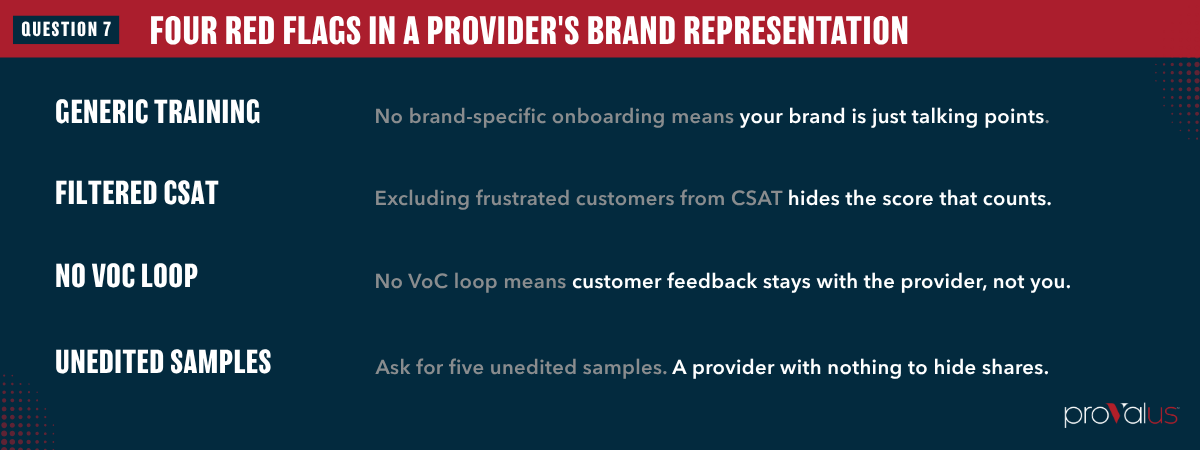
Generic agent training with no brand-specific onboarding means the provider treats your brand as a set of talking points rather than a standard to hold. CSAT methodology that filters out the most frustrated customers means the score is measuring satisfaction among people who weren't frustrated enough to leave, not the ones who were. No voice-of-customer feedback loop means the provider isn't surfacing what your customers actually said. Reluctance to share unedited call samples from comparable accounts means the provider knows what an unfiltered listen would reveal.
The proof point
Ask for five unedited interaction samples from a comparable client. Listen end to end. If the tone, judgment, and brand fidelity hold up across all five, you've heard what your customers will hear. If they don't hold up, you've heard that too, and the decision gets easier.
When Commodity Work Can Stay Commodity
A framework like this needs an honest filter, or it isn't worth trusting.
Some work is genuinely commodity: high-volume, low-risk, non-sensitive processing with minimal compliance exposure, where quality variation doesn't compound into brand or revenue damage, and the buying organization has the governance infrastructure and appetite to manage coordination across borders and time zones.
For that work, offshore delivery can fit the job. The seven questions still apply, but the answers look different. An offshore provider with strong aggregate FCR and low ticket complexity may clear every bar that matters for commodity processing, even if their attrition numbers would be disqualifying for brand-critical work.
The honest filter isn't about which delivery model is better. It's about whether the work belongs in the commodity lane. Brand-critical, compliance-bound, security-sensitive, or complex work gets pushed out of that lane toward providers who can answer all seven questions with depth, not just documentation.
How U.S.-Based Onshore Providers (like Provalus) Approach These Questions
When the work doesn't belong in the commodity lane, the delivery model starts to shape what answers are even possible. Here's how Provalus, a U.S.-based onshore provider, approaches the four questions where the model matters.
On workforce stability (Question 2)
Provalus operates purpose-built delivery centers in U.S. markets where it's the best technical employer in the area, not competing against hyperscalers and major metro tech employers for the same engineers. That's a labor market structure, not a sentiment. Lower competition for the same talent pool can support lower attrition, longer median tenure, and stronger 90-day retention.
On compliance (Question 3)
U.S.-based delivery simplifies the compliance perimeter because the provider operates under the same legal jurisdiction, regulatory frameworks, and audit obligations as the client. Cross-border data residency questions largely disappear, and escalation, overflow, and after-hours scenarios are easier to govern. When Provalus says data stays within U.S. borders, that means every scenario, not just steady-state operations.
On scalability and continuity (Question 5)
A multi-site rural delivery model gives Provalus pipeline depth in markets that aren't subject to metro wage inflation, with BCP redundancy across sites that don't share single-location exposure. The ramp story holds up because the underlying labor markets aren't collapsing under the same demand pressure that strains metro-based providers.
On brand representation (Question 7)
U.S.-based support tends to produce closer cultural and linguistic alignment with U.S. customers, and that alignment has operational consequences. Tone, escalation judgment, customer expectations, and conversational nuance are easier to train and sustain when agents share more of the customer's context. That alignment shows up in the call samples.
On the questions where the delivery model doesn’t matter
Three of the seven questions — scorecards, transitions, and knowledge management — aren't structurally about the delivery model. They're about operational discipline, and any provider anywhere can answer them well or poorly. Provalus still has to prove those disciplines through real scorecards, transition artifacts, and continuous-improvement evidence, and earns them the same way any serious provider does.
What the model does for a U.S.-based onshore provider is a structural advantage on the four questions where geography shapes the answer. For complex, brand-sensitive, compliance-bound work, the U.S.-based onshore model is the most direct path to answering those four questions well. For IT leaders evaluating providers against work that doesn't belong in the commodity lane, that fit can make the evidence easier to verify and harder to fake.
The Provider Who’s Already Answered
The traditional RFP process selects for writing quality, not operational quality. Those stopped being the same thing a long time ago.
The provider who hands you the raw scorecard, the 90-day attrition number, the SOC 2 Type II report under NDA, the brand-fidelity call samples, and the redacted transition plan from a comparable migration has already answered the question before you finished asking it.
Contact Us