BPO in the USA: What is Offshore Really Costing You?
April 23, 2026

It’s the moment IT leaders dread.


The offshore BPO contract looked airtight on paper. The rate card was compelling. The projected savings were clear. 


Then, reality set in. SLA misses started stacking up. Escalations increased. Internal teams spent more time managing the vendor than expected. Compliance audits become more complex. 


Slowly, the savings you were expecting disappear into operational drag.


The sticker price of offshore BPO is seductive. But for many, it’s deeply misleading. That’s what makes the question in 2026 more relevant than ever:
What is the true Total Cost of Ownership (TCO) of offshore BPO?

Model your U.S.-based vs. offshore TCO – on us.

Data sovereignty laws are tightening, AI is reshaping labor economics, and reshoring is accelerating across industries. The answer is no longer obvious, and the certainty isn’t universal. 


One thing is increasingly clear:
organizations that make the best outsourcing decisions are no longer comparing hourly rates. They’re comparing the total cost of ownership. 


For IT leaders operating in compliance-sensitive, quality-critical, or security-dependent environments, U.S.-based BPO (especially rural onshore delivery) represents both a cost-effective and rational option.


Why BPO Decisions Go Wrong When Buyers Lead With Price

For decades, outsourcing decisions were driven by a simple equation: lower labor cost equals lower overall cost.


That logic is breaking.


The offshore arbitrage model is eroding

The economics of BPO are shifting. Here’s how:

  • AI is narrowing the cost gap. As automation absorbs routine tasks, the labor-rate differential between offshore and domestic shrinks. The global AI-in-BPO market is projected at $49.6B by 2033. This means that providers who automate make the hourly-rate conversation increasingly irrelevant.
  • Reshoring tailwinds are rising. Reshoring, along with FDI, accounted for 244,000+ announced U.S. jobs in 2024, according to the Reshoring Initiative. High-tech sectors are driving the shift, building domestic delivery infrastructure that didn't exist a decade ago.
  • Complexity has increased. Modern IT outsourcing isn’t just ticket-handling. Security operations, compliance management, and high-impact customer interactions are not low-context tasks. 


The assumption IT leaders make and what it costs them
Most buyers treat the rate card as a proxy for cost. It isn’t. 


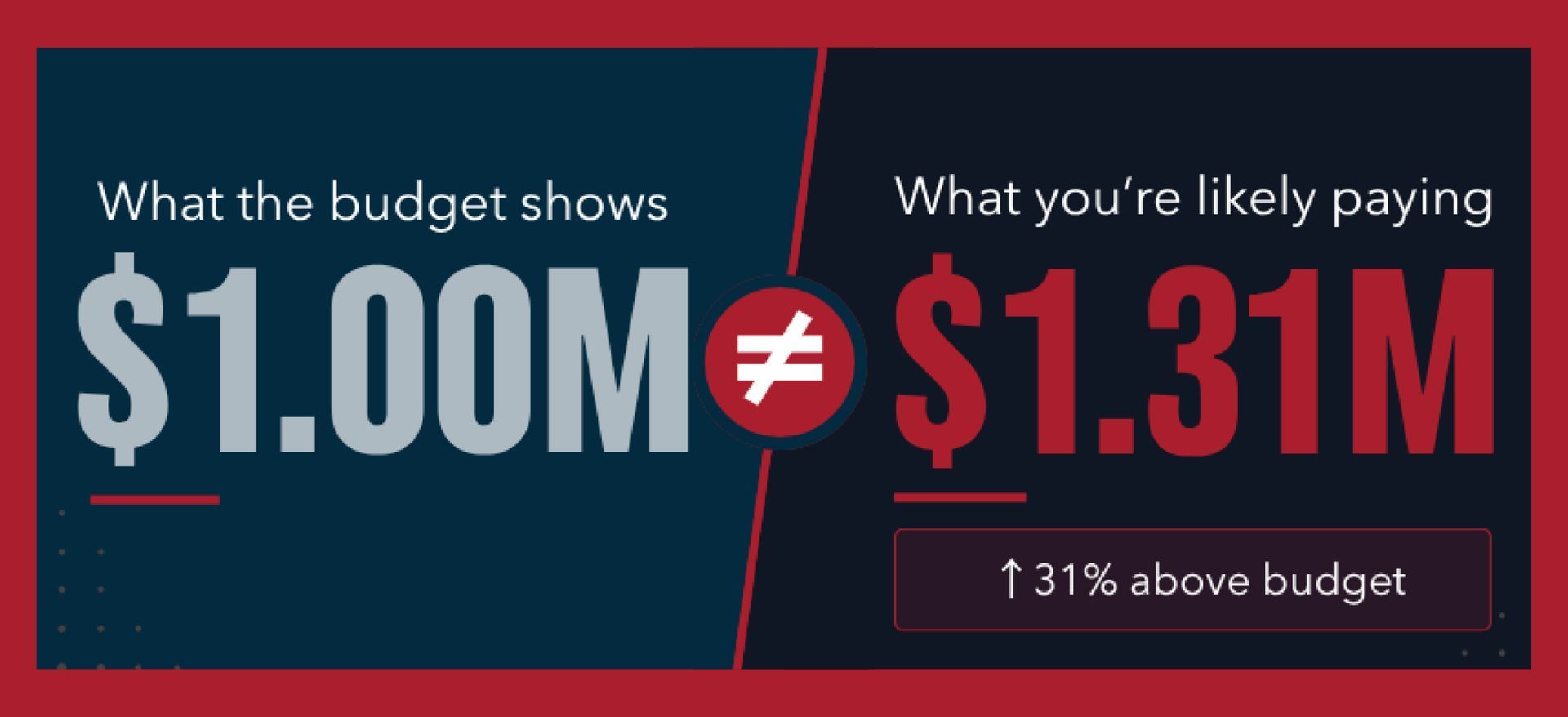
Price ≠ TCO.


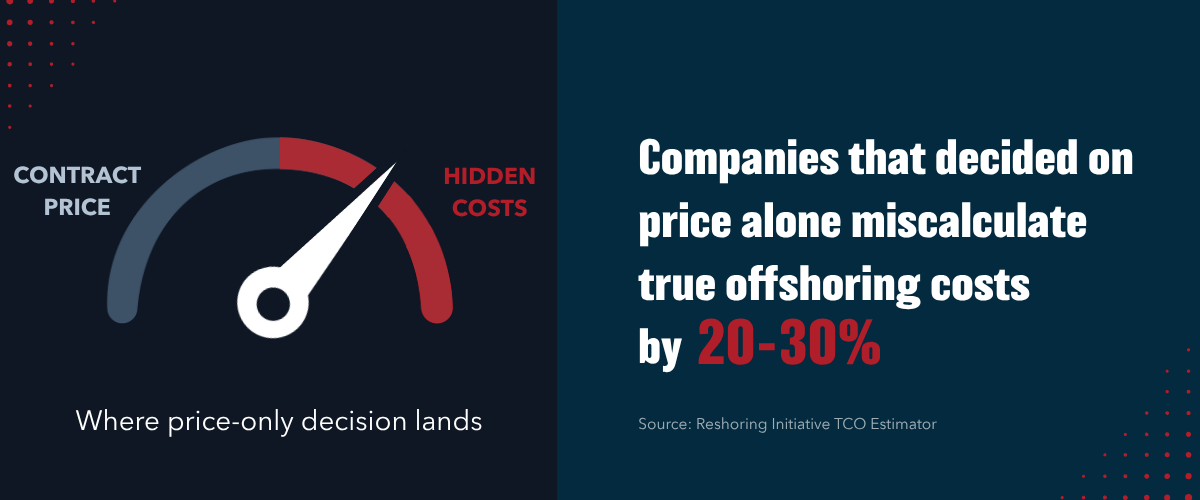
Peer-reviewed offshoring research consistently shows that buyers systematically underestimate hidden implementation costs. Additionally, the Reshoring Initiative TCO Estimator shows companies that make sourcing decisions on price alone miscalculate true offshoring costs by 20–30%.


These estimation errors increase with task complexity. That’s exactly the kind of work IT outsourcing involves.


Does this mean offshore BPO can’t work? No. But it only works when organizations fully account for what it actually costs to operate, not just buy.


The Real Cost Gap: What to Actually Compare

To properly evaluate BPO providers, you need to ground the comparison in reality instead of assumptions. Start with some publicly available statistics about the labor market to get a sense of that reality.


U.S. labor benchmarks in context

Here are some real U.S. Bureau of Labor Statistics (BLS) data points to consider:


Employer cost load:
Wages/salaries are around 70% of total employer costs; benefits add around 30%. This means the fully loaded cost is approximately 40% above the stated wage rate (BLS ECEC, June 2024)


At first glance, these might seem like numbers significantly higher than offshore alternatives. But this is just the starting point.


The rural delivery advantage

Not all U.S.-based BPO operates in high-cost metro areas. There is an advantage to providers leveraging rural outsourcing models.


Providers leveraging these models can deliver:

  • Lower cost of living (and thus lower wage pressure)
  • Higher workforce stability
  • 100% domestic compliance alignment 


This approach narrows the offshore gap before TCO is even modeled.


Building the stack: BPO Total Cost of Ownership (TCO)


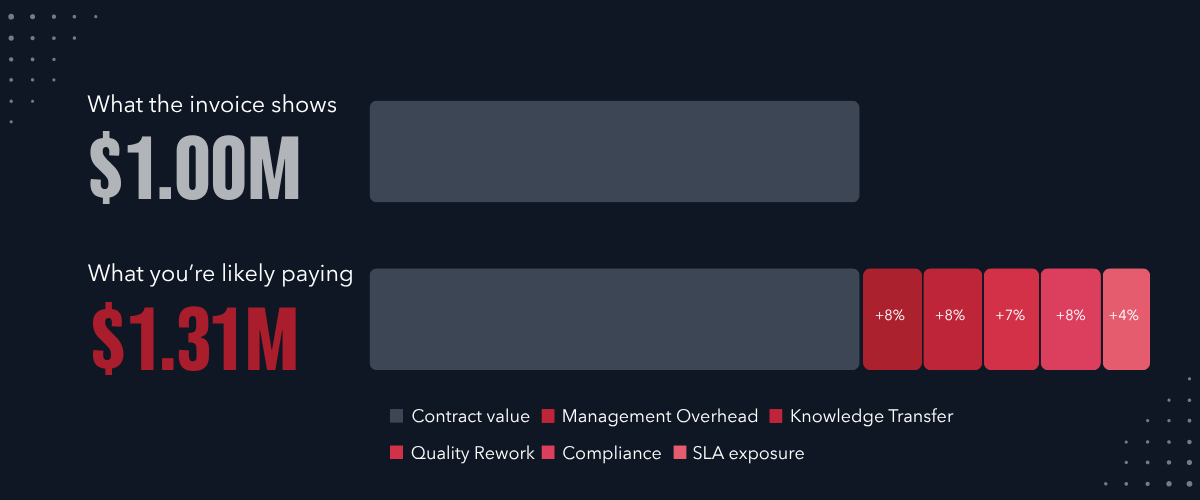
The true comparison requires five additional layers of cost:

1. Management overhead

Vendor governance isn’t free. Expect weekly or monthly operational reviews, SLA tracking, and escalation management, as well as audit coordination.

Typical impact:
6-10% of contract value.

2. Knowledge transfer

Offshore onboarding often requires significant internal effort. Senior U.S. engineers often divert 20%+ of their time for 3–6 months onboarding offshore teams. 


At a $200,000 salary, that’s
$10,000-$25,000 per offshore hire. Onshore teams reduce this significantly through:

  • Time zone alignment 
  • Real-time collaboration
  • Cultural and contextual familiarity


3. Decision latency


Time zone gaps can create delays:

  • 8-12 hour lag on escalations
  • Slower incident resolution
  • Compounding SLA risk


In high-pressure environments, these aren’t just inconveniences. They’re cost drivers.


4. Compliance perimeter costs


Managing offshore compliance often requires:

  • Additional audit controls
  • Legal oversight
  • Vendor risk management programs


Some organizations
spend up to $100,000 a year managing compliance programs tied to offshore outsourcing relationships.


Turnover and Compliance Erase “Cheap” BPO
bar chart comparing attrition scenarios and savings: 100 agents x 34% attrition x $20k per agent = 680,000. Vs 100 agents x 24% attrition x $20k per agent = $480,000.  $200k savings

Even when TCO is modeled correctly, attrition consistently erodes offshore savings and presents a silent cost multiplier. Workforce instability is one of the most underestimated risks in BPO. 


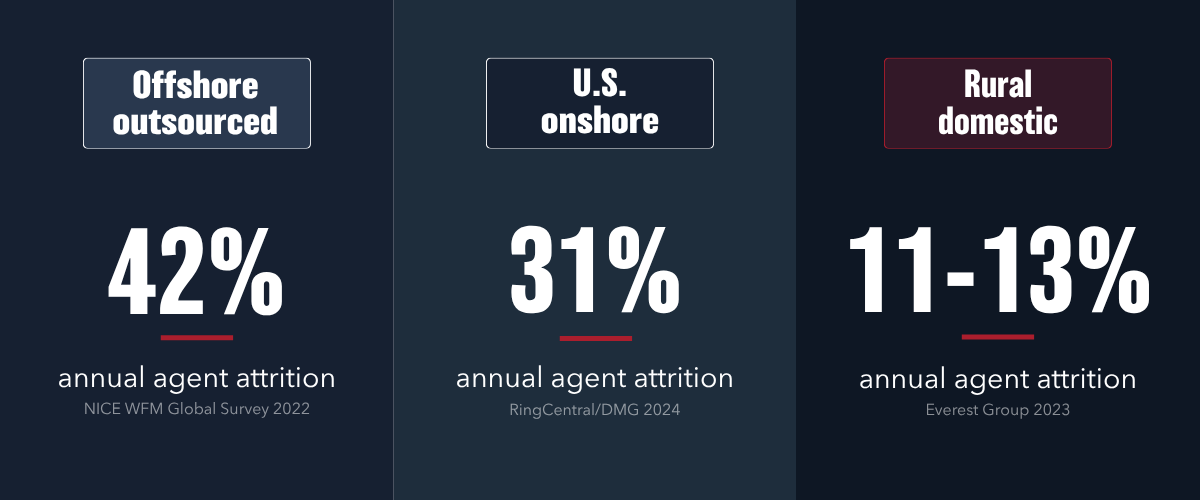
Consider that the mean annual agent attrition is around 31% in U.S. contact centers according to the RingCentral/DMG 2024 CX Benchmarking Guide, while a NICE WFM Global Survey 2022 showed that attrition is around 42% globally in outsourced providers (Annecdotal evidence from Provalus’ clients places this number much higher – around 50%).


Each turnover event costs $12,500-$15,000 in replacement and training. That’s compounded by lost productivity during ramp-up periods as well as increased error rates and SLA risk.


In IT support or security operations, this goes well beyond just a staffing issue.
It’s a problem for continuity and quality, because every time someone walks out the door, they take institutional knowledge with them.


Why retention changes the equation

Domestic providers, particularly those with purpose-built rural delivery models, often see significantly lower attrition.


According to impact sourcing research from Everest Group in 2023, workers in purpose-built community hiring models show around 11–13% annual attrition as opposed to the 18–20% for comparable non-impact operations. This is the same dynamic that drives rural domestic BPO retention.


That stability compounds:

  • Faster issue resolution
  • Higher first contact resolution (FCR)
  • Reduced rework
  • Stronger customer experience


Over time, retention becomes a
cost advantage, not just an HR metric.


Compliance exposure: The risk IT leaders can’t price last

For organizations in regulated industries, outsourcing constitutes a cybersecurity risk decision in addition to being an operational one. Offshore delivery introduces a compliance perimeter that's expensive to maintain and catastrophic to breach.


According to the IBM Cost of a Data Breach 2023 report, the average breach cost reached an all-time high of $4.45 million. It now takes companies a staggering average of 204 days to detect a breach, and another 73 days to contain it.


With domestic delivery, the compliance perimeter is simplified. All operations take place under the same legal jurisdiction with the same regulatory frameworks (HIPAA, SOC 2, PCI DSS, GLBA) and audit obligations.


At a minimum, IT leaders should require:

  • SOC 2 Type II certification
  • Documented BCP/DR testing
  • Clear data residency controls
  • Industry-specific compliance coverage


What It Looks Like When You Onshore

Case Study: Reshoring Network Operations

See more stories like Glenn's

Case Studies

The impact of BPO strategy becomes clearest when you look beyond structure and focus on outcomes.


Case study: Rebuilding network operations through onshore delivery

A large telecommunications provider responsible for supporting nearly 1 million customers across the central U.S. faced a critical inflection point with its services. Its 300-person organization needed to stand up two Network Operations Centers (NOCs) supporting E911 services and voice switching across more than 800 network switches.


Their incumbent offshore vendor quoted
an additional $1 million to $2 million to take on the expanded scope. Instead, the organization transitioned this work to Provalus, operating in a rural delivery model. The shift immediately improved communication speed and response times, eliminating the delays inherent in offshore coordination.


Just as importantly, Provalus demonstrated a rare level of flexibility, incorporating new reporting, functionality, and process improvements without constant change orders or cost escalations. The results of the shift were immediate and impactful:

  • Expanded capabilities without budget creep 
  • Reduced operational friction 
  • Meaningful gains in responsiveness and reliability

When BPO in the USA is Worth It, and When It Isn’t

Not every use case will require domestic delivery. There are scenarios where going the offshore route is still viable. Here, we’ll walk through the scenarios where domestic delivery is optimal, and where there may still be some offshore opportunities.


Scenarios where U.S.-based BPO wins on TCO:


Regulated data + audit pressure:
Healthcare, financial services, government, and defense contractors may benefit most from U.S.-based BPO. Offshore compliance management costs, data sovereignty risk, and audit complexity frequently exceed labor cost savings.


SLA penalties + complex or brand-sensitive support:
When SLA misses carry contractual penalties or direct revenue impact, and when the work involves complex troubleshooting or emotionally sensitive customer interactions, the best way to go is likely U.S.-based BPO. Resolution quality dominates the economics in this scenario.


High-churn, continuity-dependent operations:
SOC/security operations, technical support, RPA maintenance, and application development with institutional knowledge requirements are best suited for U.S.-based BPO. Offshore attrition continuously resets proficiency, and domestic retention compounds it.


When offshore still might make sense


Highly transactional, low-risk work
is one area where offshore BPO could still make sense. Non-sensitive, high-volume commodity processing with minimal compliance exposure could work outside the U.S.


Quality degradation
not being detrimental to brand or revenue damage is another possibility for offshore work.


Additionally, if an organization has the
governance infrastructure and the appetite to manage coordination, oversight, and compliance overhead effectively, it could still maintain offshore BPO.


The Question Isn’t Cost. It’s Risk.

If you’ve been asking yourself if you could afford U.S.-based BPO, it’s time to acknowledge that was never the right question.


Instead, ask yourself: “Can we afford the compounding cost of getting this wrong?”


For IT leaders managing compliance exposure, SLA accountability, and operational continuity in 2026, domestic BPO (particularly from purpose-built rural delivery centers) is increasingly the answer that holds up when you run the full numbers.


If all those things matter to you and your business, reach out to Provalus, and we’ll help you get on the road to meeting and exceeding your goals.


Explore how a U.S.-based BPO model could impact your cost, performance and risk profile
March 30, 2026
Mike Keogh, President of Provalus, was recently featured in Newsweek with an op-ed titled “Here’s How One Woman Is Creating History in a Small Texas Town.” In the piece, Keogh highlights the inspiring story of one woman who transformed her career from a desk agent to a delivery manager, overseeing 400 people. Her journey not only advanced her own career but also paved the way for others to follow her lead. In rural America, women make up approximately 48% of the workforce, yet only hold 37% of stable, well-paying jobs with benefits. In his article, Mike highlights the inspiring story of one woman who transformed her career from a desk agent to a delivery manager, overseeing 400 people. Her journey not only advanced her own career but also paved the way for others to follow her lead. At Provalus, we see this impact daily. By delivering training and tech roles to underserved communities, we create a new generation of talent ready to strengthen America’s future. Women are a core part of that mission, bringing fresh perspectives that elevate performance and strengthen the communities we serve. We are proud to honor these contributions and to continue supporting the next wave of American workforce leaders.  Read the full article here .
March 26, 2026
Today, Provalus is pleased to announce a formal partnership with The PenFed Foundation for Military Heroes. This partnership will focus on our mutual missions to provide a smooth transition from military service into sustainable civilian careers.
March 18, 2026
The Meridian Program is a unique partnership approach to college-level internships designed to equip STEM and Computer Science students with the skills and experience needed to launch successful careers in IT.
March 13, 2026
Provalus hosted a ribbon-cutting ceremony on March 3rd for the grand opening of our newest Center of Excellence in North Wilkesboro, NC, marking our second location in North Carolina.
February 25, 2026
Today, Provalus is pleased to announce the expansion of our Meridian Program to include three new partners: North Arkansas College, Arkansas State University, and Louisiana Tech University.
January 13, 2026
Investing in rural America is often framed as a social good. Increasingly, it is also a business advantage. When companies place high-quality, onshore careers in rural communities, they tend to unlock unusually strong workforce stability, because people are able to build long-term careers without leaving the places the
December 30, 2025
As we close out the year and prepare for 2026, we’re taking a moment to pause and reflect on all we’ve accomplished in 2025. Because of your support, we’ve been able to impact so many throughout the year.
December 4, 2025
Optomi Professional Services (OPS), announced today that Nick Murphy has been appointed Chief Operating Officer effective December 1, 2025.
NewsNation Morning in America
November 25, 2025
On the heels of their visit to our Brewton Center of Excellence, CEO Chuck Ruggiero had the pleasure of joining Alex Caprariello for a live interview on NewsNation’s Morning in America.
November 17, 2025
As fraud threats grew more sophisticated, a leading U.S. credit union found their Fraud Operations teams falling behind. Performance lagged with no scalable staffing approach, and turnover plagued its remote workforce.
Show More