Why Dedicated Teams Beat Shared Pools for IT Support
Your engineer loses access to a deployment pipeline on a Friday afternoon and calls support. If ticket volume on your account has been low, the agent who picks up won't be deeply familiar with it, and their attention is split across other clients too.
Choosing between dedicated and shared support comes down to how much context your support team is allowed to carry.
- Shared support pools split agents across multiple client accounts. Dedicated teams don't.
- That split shows up as slower fixes, more security exposure, and institutional knowledge that resets every time someone leaves.
- Across four Provalus accounts: 81% faster resolution, 97.2% fraud-team retention, 74% reduction in security incident backlog.
- Dedicated isn't the right model for every account. The honest read on when a shared pool still wins is below.
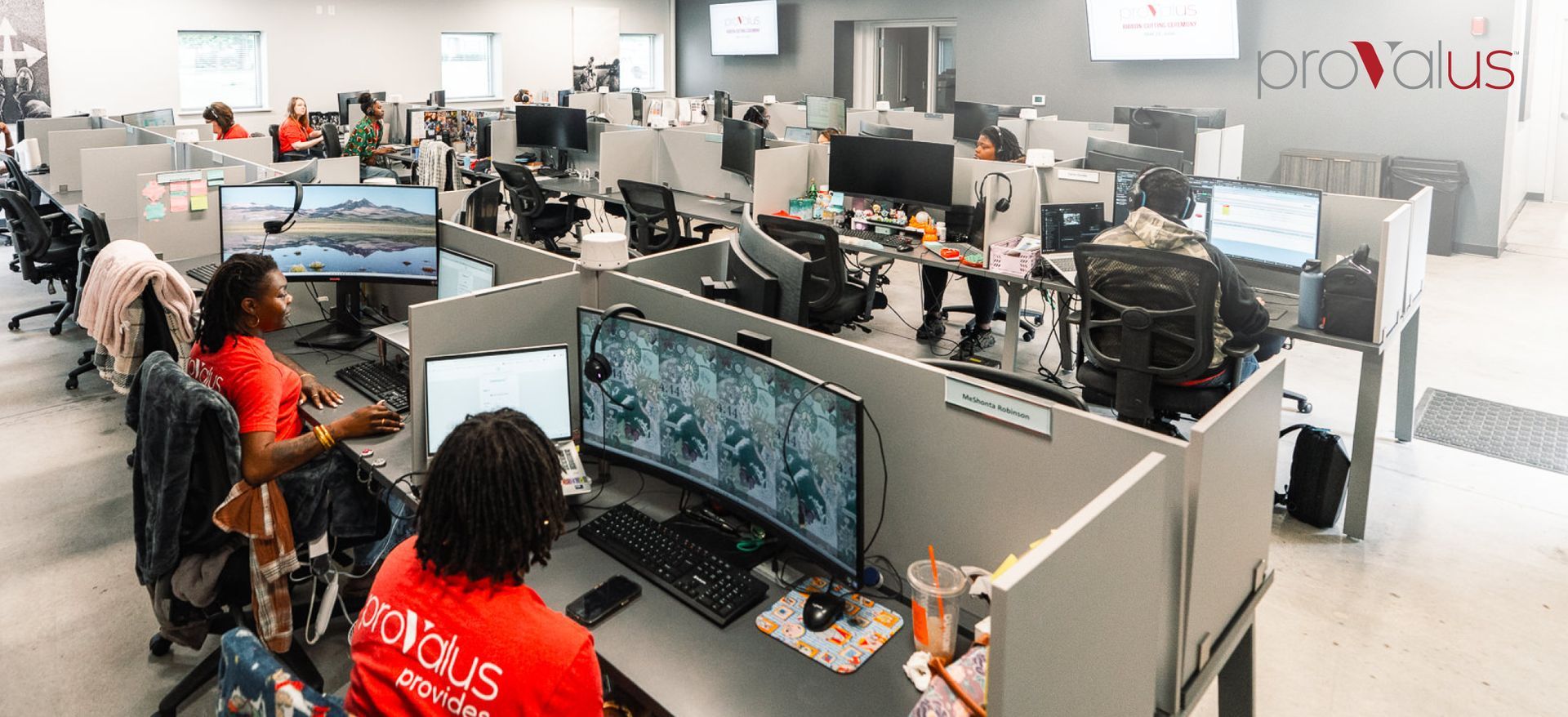
Your environment: the same dedicated team, all day long.
Why IT Support Depends on Context
Every environment has its own logic: which systems talk to which, which errors are cosmetic, which ones page someone at 3 a.m., and which users lock themselves out every Monday. None of that lives in a ticketing system. It lives in the person who has seen it before.
A dedicated team builds that familiarity once and keeps it. A shared pool's familiarity depends on how often an agent's attention actually lands on your account, and low ticket volume means it doesn't land often enough to stay deep, which is where slow resolutions, repeated questions, and small security mistakes come from.
The Research on Interrupted Attention
Gloria Mark, a researcher at UC Irvine, has spent two decades studying what happens when people get interrupted mid-task. Her finding: it takes an average of 23 minutes and 15 seconds to return to an interrupted task, largely because people detour through other work before getting back on track.
A support agent juggling four client environments faces this exact lag: every ticket from a different account forces a context switch, pulling their focus away and dragging out the time it takes to get back to solving your problem.
The Hidden Cost of Shared IT Support Pools
Most IT leaders price a support contract by the seat or by the ticket, but the real cost driver is escalation: a dedicated team builds institutional knowledge faster than a shared pool ever can, and that knowledge is what turns into savings.
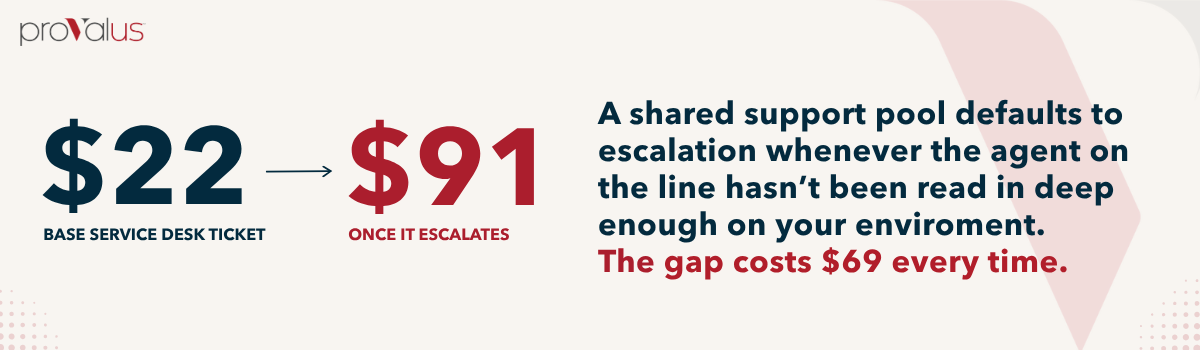
MetricNet's Service Desk and Desktop Support Benchmarks put a clear number on the cost of escalation itself. The Service Desk data shows a typical ticket costs about $22 to resolve, and the Desktop Support data shows that if the ticket escalates past the first tier, it adds another $69, a total of $91 for the exact kind of issue a dedicated agent would typically close on the first call. In a shared pool, escalation is the default outcome whenever the agent on the line hasn't been read in deeply enough on your environment.
How Dedicated Teams Improve Resolution Speed and Consistency
The First-Contact Resolution Numbers
First-contact resolution is one of the more reliably measured numbers in this industry, and the benchmarks are consistent:
- SQM Group's historical benchmark: 70% average first-contact resolution across industries generally.
- MetricNet's desktop support data, closer to the specialized work dedicated teams handle: 84% average, up to 97% for top performers
- The Consortium for Service Innovation's Knowledge-Centered Service research: tickets resolved 50 to 60% faster, and first-contact resolution 30 to 50% more often, when a living knowledge base exists
- Industry SLA benchmarks: 90 to 97% first-response compliance, 70 to 90% P1 restore compliance, and a service credit risk of 5 to 15% on a single missed ticket
For your team, that gap is the difference between an engineer who's back into the deployment after one call and one who gets bounced to a second or third agent while the release sits blocked.
A dedicated team is, by definition, a defined tier: one group, one set of runbooks, and one escalation path that doesn't change depending on which client happens to be in the queue.
A Global Media Service Desk
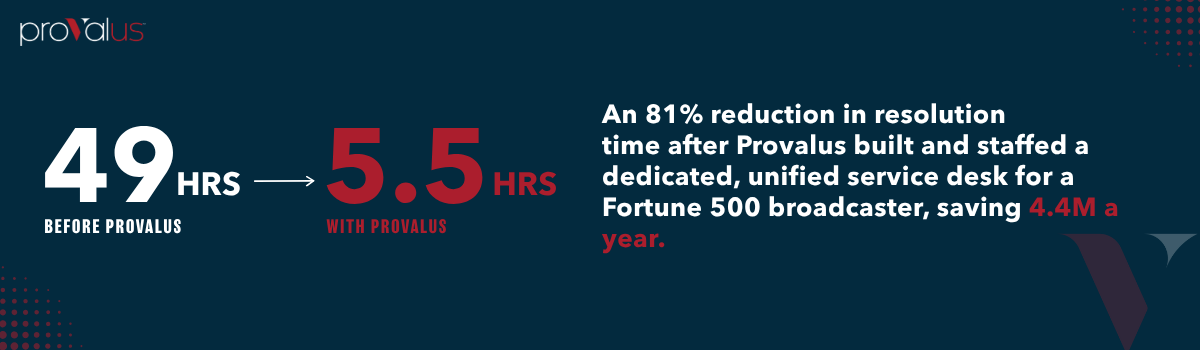
Provalus saw this with a Fortune 500 media company’s global service desk: resolution time fell from 49 hours to 5.5, an 81% reduction, after Provalus built and staffed a dedicated, unified desk, saving the client roughly $4.4 million a year. Average tenure on the account was 1.5 years, long enough for that knowledge base to actually get built.
None of that survives an agent rotation: a new person picking up an account without that depth resets the tier, lets the knowledge base go stale, and turns the 70% baseline into the best case, not the floor.
Why Dedicated Teams Reduce Security and Access-Control Risk
A shared support pool is, from a security standpoint, a shared attack surface: every agent working across multiple accounts is a credential, a login, and a set of permissions to manage at once.
Verizon's 2025 report found third-party breach involvement jumped to 30%, double the year before; SecurityScorecard puts it higher, at 35.5%. IBM's 2025 report puts the average third-party breach at $4.91 million, about $470,000 more than the global average.
The Case of Crunchyroll
The Crunchyroll breach in 2025 makes this concrete: reporting traced the intrusion to a support agent's compromised login at Telus International, a BPO provider on the account, and attackers reportedly extracted around 8 million support ticket records through that single point of access.
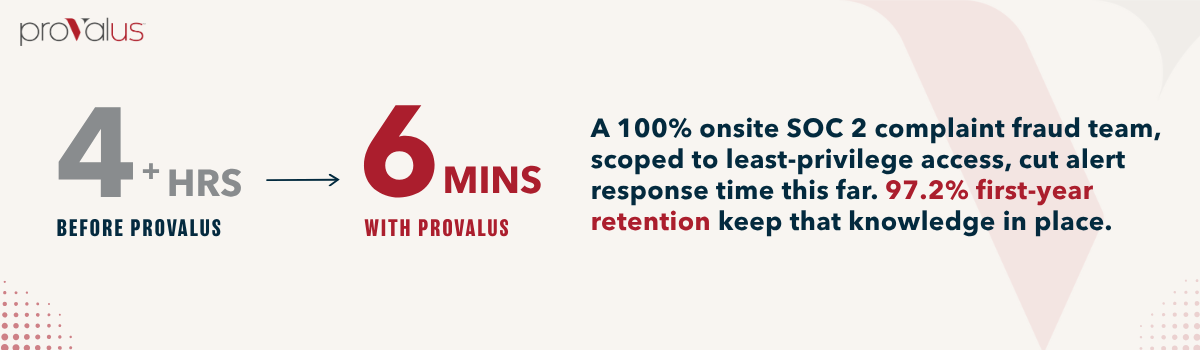
A dedicated team can be structurally isolated in a way a shared pool cannot, scoped to what the account needs, the least-privilege principle NIST recommends. Provalus built a national credit union's fraud team that way: 100% onsite, SOC 2 compliant, every resource cross-trained, none touching another client's systems. Overnight fraud alert response dropped from four-plus hours to six minutes, and first-year retention held at 97.2%. A separate Provalus SOC engagement for a Fortune 300 manufacturer cut the security incident backlog by 74% and improved detection speed by 76%, with 100% SLA throughout.
Why Institutional Knowledge Matters in IT Support
Every internal user, whether it’s an engineer locked out of a pipeline or a finance director who can’t access payroll, judges support by whether they have to explain the same problem twice.
SQM Group ties each 1% improvement in first-contact resolution to a 1% lift in employee satisfaction: fewer escalations reaching a manager's desk. A dedicated agent who already knows an engineer's VPN quirk, or a finance system's quarter-close workaround, resolves it without making the user re-explain their environment.
The Turnover Math
Every environment accumulates knowledge nobody wrote down:
- The router that needs a manual reboot twice a year
- The vendor contact who actually picks up the phone
- The workaround for a legacy system nobody has budget to replace
That knowledge lives in people, not documentation, until someone forces it into documentation.
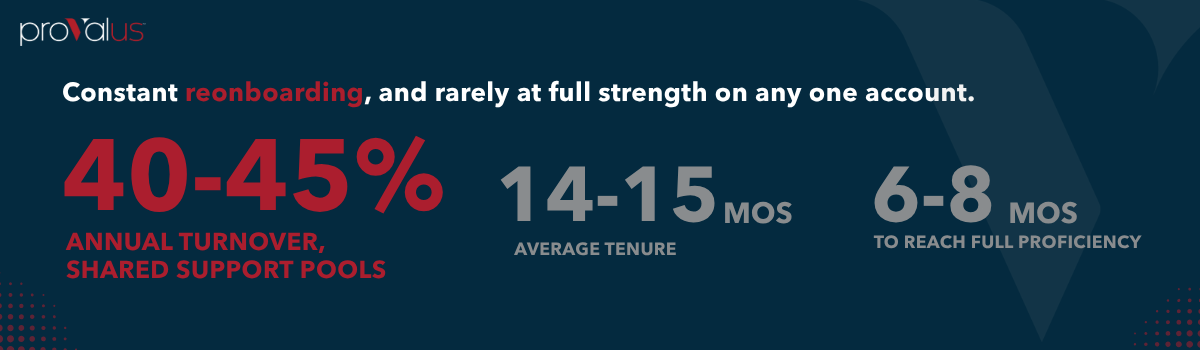
A shared pool is structurally bad at holding onto that knowledge, given how the industry retains people. Insignia Resources' 2026 research puts the numbers at:
- 40 to 45% annual turnover
- 14 to 15 months average tenure
- Another 6 to 8 months before a new agent reaches full proficiency
That's vendor-published research, not academic data, so read it as directional, though the shape of the problem holds: a shared pool is constantly re-onboarding, rarely at full strength on any one account.
Provalus ran that exact rescue for a telecom client whose legacy systems lived almost entirely in people's heads: five of the client's own former employees were re-badged onto the new dedicated team, undocumented procedures finally got written down, and the account saved more than $500,000.
When a Shared Pool Still Makes the Right Call
None of this means dedicated support is the right model for every account, and a piece that pretended otherwise wouldn't be worth trusting.
Standardized, low-volume ticket work, with clear scripts and minimal variation, doesn't need deep environmental context, because there isn't much environment to learn.
Seasonal or elastic volume can also favor a shared pool: a fixed dedicated team is limited by exactly the headcount it's staffed with, and can't absorb a sudden spike the way a larger shared bench can.
The Single-Point-of-Failure Risk
A dedicated team is only as strong as its backup plan. A single dedicated technician with no cross-training and no coverage plan isn't more secure or more consistent than a shared pool. They're a single point of failure wearing a better title.
Operational continuity is a genuinely two-sided problem: dedicated teams solve the environmental side of it- the deep knowledge of one system- but only solve the capacity side if the provider actually staffs redundancy into the account instead of one person and a hope.
How Provalus Puts the Dedicated Model to Work
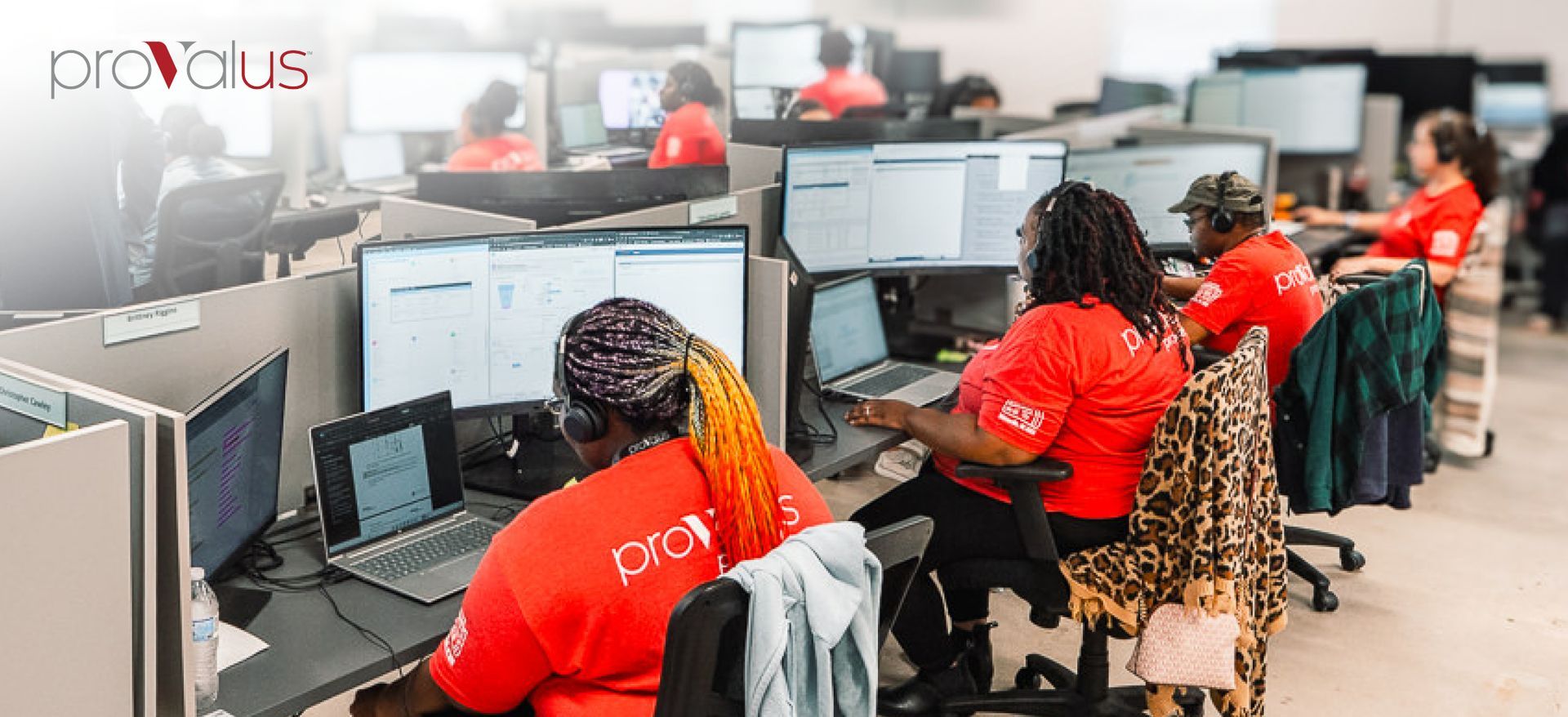
Provalus builds every account this way by default, not as a premium tier: 100% dedicated, 100% onsite, inside SOC-2 compliant, BCP-tested facilities operating 24 hours a day, every day of the year.
The Support Stack Behind Every Team
The honest filter above named the real risk: a single point of failure disguised as expertise. Provalus answers that with a full support stack behind every team:
- Project managers
- Business analysts
- QA staff
- A knowledge management function
- Workforce management
These sit behind the account, and a Hypercare bench covers absences and volume spikes so the account never depends on one irreplaceable person.
If you've been pricing outsourced IT support by hourly rates or seat counts, that's the wrong comparison. Ask instead how much this team already knows about the environment, and how much will still be there in a year. A dedicated team answers both with a yes; a shared pool can't.
Get in touch
Talk to Provalus about what a dedicated service desk, NOC, or SOC team would look like for your environment.
Contact Us